


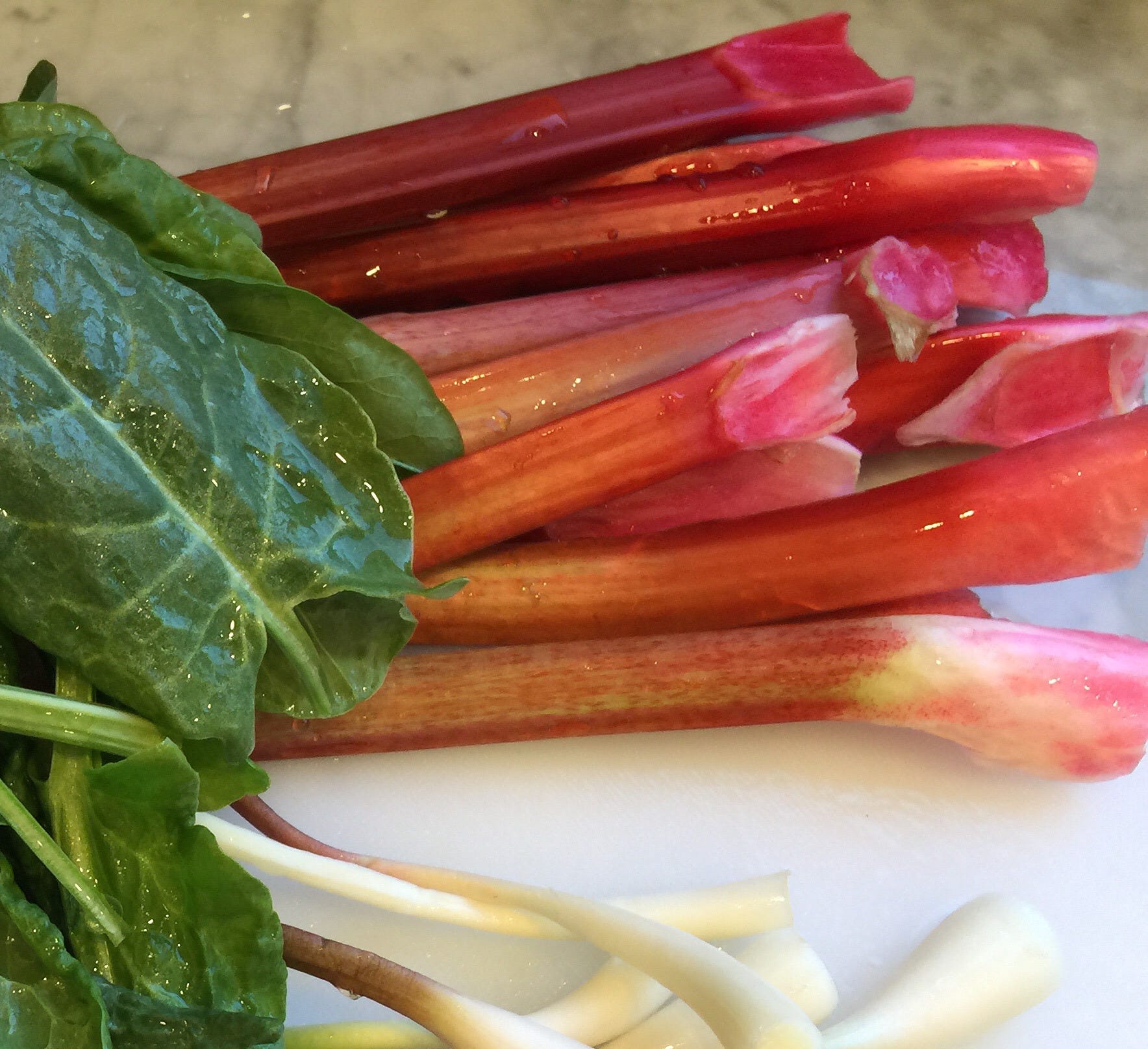
RHUBARB IS AN ODDITY in being a sour vegetable of spring that is treated mostly as a fruit, thanks to its tangy, green, fruity flavor, and is available before any actual fruit is. It’s most at home in areas with cold winters; at this date, mine is not much more than a foot tall. As the season advances, the plants don’t hold back. In rich soil with plenty of organic matter, from edge to edge they’re six to eight feet across, and hollow stalks as tall as you are bear showy white flowers. It helps to divide the plants every four or five years, but they live for decades. I did manage to kill a pair of them a few years ago by mulching too heavily and closely, which produced crown rot. A friend gave me replacements (you don’t start plants from seed as a rule). They’re probably Canada Red, an excellent variety that dates from the 1920s or 30s and is known for its redness, for being less fibrous than many varieties, and for being relatively sweet. Other red-stemmed varieties are also very good.
As a plant, rhubarb pretty much takes care of itself. The one thing I’ve always done is to cut off the flowering stalks as they appear in order to preserve the plant’s energy. But on his informative website Rhubarborium, Christian Sauvé says that it’s fine to let the flowers open and enjoy them, and then cut them when they fade. It’s only producing seed that weakens the plant.
Summer heat turns the stalks tough and stringy, although even in midsummer I’ve tasted tender rhubarb from rich, well-watered soil. As a point of comparison with Canada Red, I used to grow an old farm rhubarb, from back before varieties were selected for red color. Its entirely green stalks were less flavorful and very acid. (None of this is to get into the especially British phenomenon of rhubarb forced in the dark, which is available from January on.)
You harvest rhubarb by pulling and twisting the stalks. Then the uncomplicated thing to do with them is cut them up, sprinkle on sugar to draw out the juices, and cook them, carefully stopping before the rhubarb turns to mush. Rhubarb acidity varies, so it’s best to hold back on the sugar at first and then, when the rhubarb has cooled to warm, taste and add more. To me, better than sugar is honey, and if the honey is added after the rhubarb is done, so it stays uncooked (as in this version), that shows off the honey. One of the first times I did it, the honey produced a wonderful peach flavor. (I never had quite the same honey or effect again).
Among combinations, cream and custard help balance the tartness. I don’t quite understood the popular rhubarb-strawberry mix because the flavor of each is just diluted; they’re much better on their own. Orange is also common with rhubarb, but I’m more attracted to floral and spice complements that don’t compete: rose, elderflower, angelica, cardamom, voatsiperifery. Straight-up rhubarb pie is classic, but the cooking draws out so much juice that the bottom crust is soggy. My solution is to make open individual tarts. Their small size and shallowness give more edge and surface, so more liquid evaporates. I’ve never explored the savory uses of rhubarb, such as the Persian combination with lamb, which parallels the northern European pairing of fruit with meat, for instance apples with pork, which offsets the meat’s richness.
And you can drink rhubarb. The usual way is to cook the rhubarb in a lot of water and sugar, then strain it and dilute it further and serve it with mint, Persian-style. But if you really want to know and enjoy rhubarb, you can prepare it similarly as an elegant raw spring drink, which is a revelation. It’s the purest way to enjoy rhubarb (the cooked version is with the recipe, too, and it’s very good, but not on the same plane). A raw spring rhubarb drink may be the most special and unusual thing I’ve ever written about. ●
Have you tried the combination with raspberries? Lightly cooked rhubarb, raspberries only added at the end. Served with a very light vanilla bavaroise. One of my absolute favorites.
Ed, I took a devilish delight in your terse dismissal of the strawberry-rhubarb pie! I have never understood it. It always seemed as though the rhubarb was being used as a filler for the pie, and yet, strawberries are sufficiently abundant and cheap (well, perhaps I should be careful assuming that is true in Trump 2.0 America!) that nothing would be gained by that exercise. Also, tastes differ, but a cooked strawberry pie never appealed to me (the strawberry can never stand up to apple, cherry, peach or even blueberry in a pie) when one can stack a bunch of perfectly ripe strawberries in a good pie crust and drown them in whipped cream (adding strawberry-flavored goo if one must!). I have not had rhubarb here in Italy, but it is around in season, and i italiani do eat it. (And yes, the strawberry-rhubarb torta is found here, too!) It is funny, but many Italian recipes elect to call rhubarb "Nordic" or "German" in passing. Lastly, the Persian idea of lamb and rhubarb really appeals to me, so I may look into that. The Italians apparently use rhubarb in a range of dishes with fish and roasted meats...